
Assessing summer weight loss: when is action needed?

18 September 2022
-
5 minutes

Before deciding whether corrective action is required, it is important to understand what normal body condition changes look like on your farm.

Weight loss and backfat loss during lactation vary between farms, genetics and production systems. This means that absolute values should always be measured and evaluated within the context of your own herd.

Regular monitoring of sow body weight and backfat thickness provides valuable insight into how animals are coping with lactation demands and seasonal challenges such as heat stress.

Comparing farm data with benchmark information from similar production systems can help determine whether observed losses fall within an acceptable range or whether intervention is required.

What is an acceptable level of weight loss?
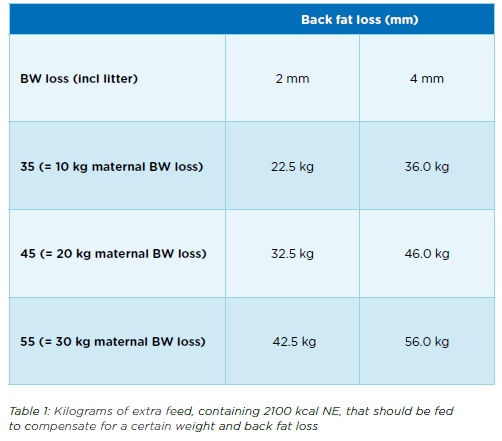
Some degree of weight loss during lactation is inevitable and should not automatically be considered a problem. As a practical guideline, total weight loss from pre-farrowing until weaning should typically remain within 17-20%, including approximately 25 kg of litter weight. This corresponds to roughly 8-12% maternal body weight loss.
Backfat targets vary according to genetics, but for many modern sow lines a backfat level of approximately 11-13 mm at weaning is considered desirable.
When weight loss and backfat loss remain within these limits, negative effects on subsequent reproductive performance are generally limited.
 

Compensating for Excessive Lactation Losses

Periods of heat stress can increase the mobilisation of body reserves and result in greater-than-desired losses during lactation. When body condition loss becomes excessive, part of this loss should be recovered during the early stages of gestation. 
 
The amount of additional feed required depends on the level of compensation desired. Calculations indicate that restoring body weight requires substantial energy intake. Similar principles apply when rebuilding backfat reserves.
 
However, body weight and backfat development should not be viewed independently. Both are closely linked and should be assessed together when deciding on compensatory feeding strategies.

Focus recovery in early gestation

The most effective time to restore lost body condition is during the first 35 to 45 days of gestation.
This provides the sow with an opportunity to recover adequate body reserves before the nutritional demands of late gestation and subsequent lactation begin.
When implementing a compensatory feeding strategy:
  • Assess body weight and backfat together.
  • Set realistic recovery targets.
  • Increase feed allowances in a controlled manner.
  • Monitor progress regularly.
  • Adjust feeding according to individual sow requirements.
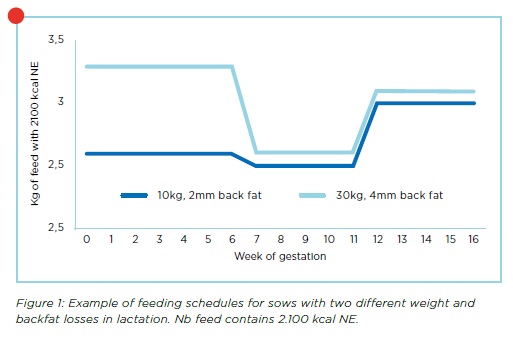
The goal is not simply to add extra feed, but to restore the sow to the desired condition before the next production cycle.

Look beyond compensation

While additional feeding during early gestation can help restore lost condition, it should not be considered a complete solution.
Compensatory feeding addresses the consequences of excessive weight loss but does not solve the underlying cause.
For a sustainable long-term approach, producers should evaluate all factors affecting feed intake and body condition during lactation, particularly during warm periods. These may include:
  • Feed quality and nutrient density
  • Feeding management
  • Water availability
  • Environmental temperature
  • Ventilation
  • Sow comfort
  • Transition feeding strategies
  • Lactation feed intake management
By addressing the causes of excessive summer weight loss, farms can improve both current litter performance and reproductive results in the following cycle.

Contact our swine specialists for advice

Keep in mind that feeding extra feed in early gestation is only alleviating the symptoms of an increased weight loss in lactation. For a more long-term solution, you should look at all aspects affecting feed intake and weight loss in lactation, even in summer.